Why Road Marking Material Selection Matters
Road markings are safety-critical infrastructure. Lane lines, pedestrian crossings, stop lines, directional arrows, and speed markings guide vehicle and pedestrian behaviour in ways that directly affect accident rates. The longevity and retroreflectivity of road marking paint determines how reliably this guidance functions , particularly at night and in wet conditions when driver reaction time is most dependent on clear, visible markings. Choosing between thermoplastic road marking paint and conventional road marking paint is therefore not simply a procurement decision , it is a safety engineering decision.
Conventional Road Marking Paint
Chemistry and Application
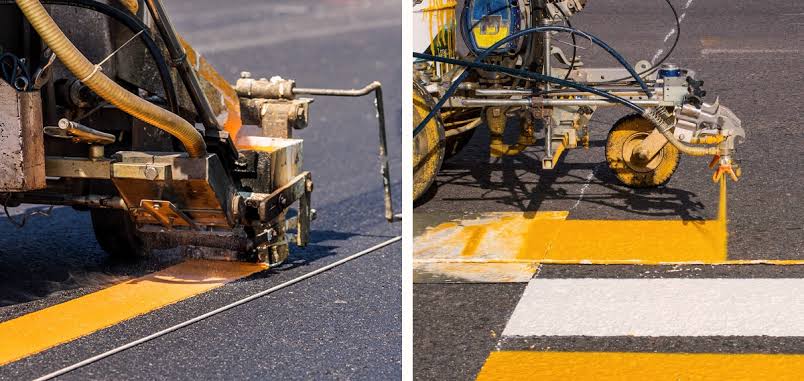
Conventional road marking paint is a solvent-borne or water-borne paint applied by spray or extrusion at thicknesses of 300 to 600 microns. Retroreflective glass beads are either pre-mixed into the paint or drop-applied to the wet surface immediately after application. Cure time is determined by solvent evaporation or water evaporation, and road surfaces can typically be reopened to traffic within 15 to 30 minutes.
Advantages of Conventional Road Marking Paint
- Lower equipment cost: application equipment is simpler and less expensive than thermoplastic hot-application rigs
- Fast drying: water-based traffic marking paint variants in particular offer rapid re-opening times
- Good for temporary markings: where markings need to be changed or removed, conventional paint is more easily modified than thermoplastic
- Cost-effective for lower-traffic applications: car parks, warehouse and factory floors, and pedestrian areas where longevity requirements are less demanding
Limitations
Conventional road marking paint has a service life of typically 12 to 24 months on high-traffic highway surfaces before retroreflectivity and visibility fall to unacceptable levels. The relatively thin film is susceptible to tyre wear, making it unsuitable for the highest-traffic road environments.
Thermoplastic Road Marking Paint
Chemistry and Application
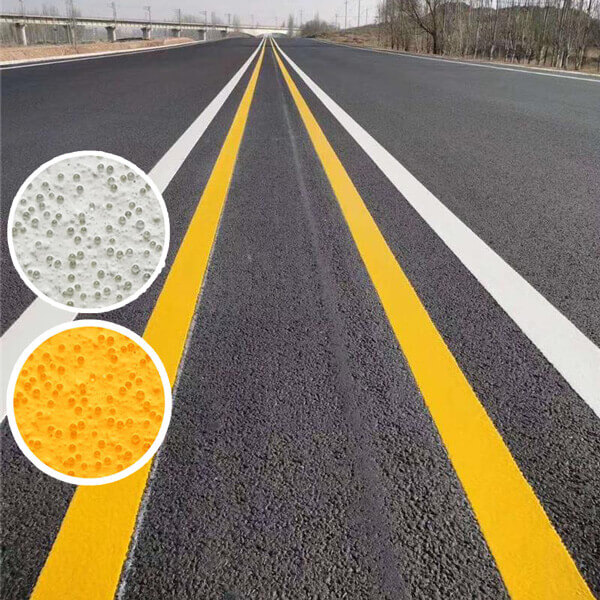
Thermoplastic road marking paint is a solid material , a blend of hydrocarbon or alkyd resin, fillers, pigments, and glass beads , that is heated to 180 to 220°C before application. In the molten state, it is applied by extrusion or screed to the road surface at a thickness of 1.5 to 3mm. On cooling, it bonds to the road surface and cures hard within minutes, allowing very rapid return to traffic. Additional retroreflective glass beads are drop-applied to the hot surface immediately after laying.
Advantages of Thermoplastic
- Superior durability: at 1.5 to 3mm thickness, thermoplastic highway marking paint typically delivers three to seven years of service life on high-traffic surfaces , two to five times that of conventional paint
- High retroreflectivity: the thick film allows greater glass bead loading, producing higher initial retroreflectivity and maintaining acceptable retroreflectivity for longer as the bead-rich surface layers wear
- Rapid road reopening: solid cure on cooling means thermoplastic markings can accept traffic within minutes , a critical advantage in busy urban and highway environments
- Resistance to fuel and oil contamination: the thick, hard-wearing thermoplastic film is more resistant to surface contamination that can reduce conventional paint adhesion and visibility
Limitations of Thermoplastic Road Marking Paint
- Higher equipment cost and operator skill requirements for heated application equipment
- Less flexible than paint , can crack in very cold conditions in high-altitude or seasonal cold regions of India
- More difficult to modify or remove if marking layouts need to change
Reflective Road Paint: The Retroreflectivity Imperative
Both conventional and thermoplastic road marking systems must incorporate retroreflective elements , typically glass microspheres , to function as effective reflective road paint at night. Retroreflectivity is measured in mcd/m²/lux, with minimum values specified in Indian road standards for different road categories. The initial retroreflectivity of a new marking and the rate at which it decays with traffic wear are critical specification parameters , a major cost driver of thermoplastic road marking paint’s higher initial cost is its superior retroreflectivity longevity.
Industrial Road Marking Paint: Considerations Within Facilities
Within industrial facilities , factory yards, warehouse access roads, logistics parks, and port areas , industrial road marking paint selection follows similar principles but with additional considerations:
- Chemical resistance: areas subject to fuel, oil, or chemical spills require chemically resistant road marking formulations
- Anti-slip: factory yards where forklifts and HGVs operate require anti-slip aggregate in the marking system
- Floor-compatible systems: warehouse internal road markings must be compatible with the floor coating system and applied using equipment appropriate for indoor use
Ashok Paint Agencies: Road Marking Solutions
Ashok Paint Agencies supplies both conventional and thermoplastic road marking paint products for highway, infrastructure, and industrial road marking applications. From standard traffic marking paint for car parks and internal roads to high-retroreflectivity highway marking paint for national highway projects, our product range covers the full spectrum of road marking requirements. Contact our team at ashokpaintagencies.com for product specifications and pricing.