Two Families Within One Chemistry
Polyurethane coatings are among the most versatile and widely used finish coats in industrial painting. But within the polyurethane coating family, there is a critical division , between aliphatic and aromatic chemistry , that fundamentally determines where each product can be used and how it will perform over time. Confusing the two, or specifying the wrong type for a given application, is one of the most consequential coating specification errors in industrial painting practice.
The Chemistry Behind the Difference
The distinction between aliphatic and aromatic polyurethane lies in the isocyanate component used in the formulation. In an aromatic polyurethane coating, the isocyanate is aromatic , it contains benzene ring structures. In an aliphatic polyurethane paint, the isocyanate is aliphatic , it has a straight or branched chain structure without aromatic rings.
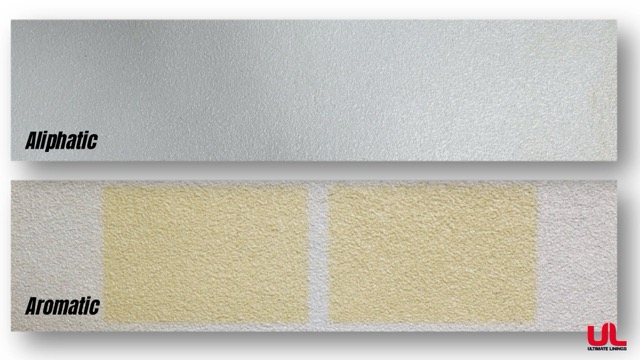
This seemingly subtle chemical difference has a profound practical consequence. Aromatic ring structures absorb ultraviolet radiation strongly, causing the polymer chains in the cured film to break down when exposed to UV light. Aliphatic structures do not absorb UV in the same way, so aliphatic polyurethane coatings remain stable and retain their optical properties , gloss, colour, and surface integrity , under prolonged UV exposure.
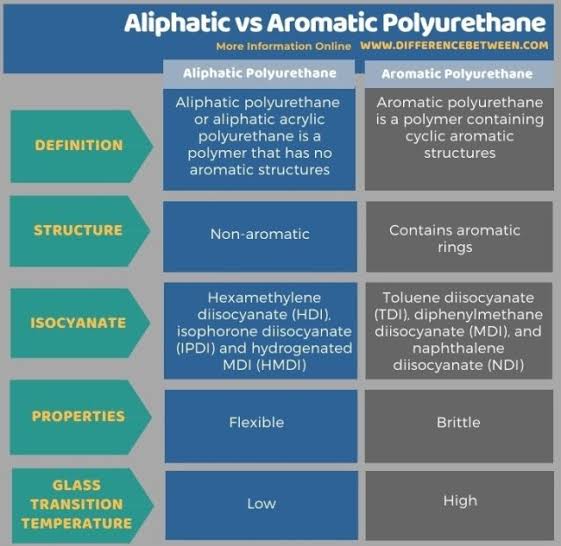
Aliphatic Polyurethane Paint: The Topcoat of Choice
UV Stability and Colour Retention
The defining characteristic of aliphatic polyurethane paint is its resistance to UV degradation. Where an aromatic system will chalk, yellow, and fade within months of outdoor exposure, an aliphatic system will retain gloss and colour for years. This makes aliphatic polyurethane the mandatory choice for exterior atmospheric topcoats on bridges, industrial structures, chemical plants, power stations, and any structure where appearance and long-term surface integrity matter.
Applications for Aliphatic Polyurethane
- Exterior topcoat on structural steel bridges, flyovers, and industrial buildings in all corrosivity categories
- Topcoat on oil and gas surface facilities, storage tanks, and process plant structures
- Finish coat on chemical plant structures requiring colour-coded zone identification and chemical splash resistance
- Marine topside coatings where gloss retention is required for inspection visibility and aesthetics
- High-value infrastructure where long maintenance intervals are required and topcoat degradation would trigger costly repainting programmes
Aromatic Polyurethane Coating: Where It Still Has a Place
Cost Advantage
Aromatic polyurethane coating is significantly less expensive than aliphatic , the difference can be substantial per litre. Where UV exposure is not a factor, or where colour retention is unimportant, this cost advantage makes aromatic PU paint an attractive option.
Underground and Internal Applications
For internal surfaces, buried pipelines, and underground structures where UV exposure is absent, an aromatic industrial polyurethane coating provides chemical resistance, abrasion resistance, and barrier performance at lower cost than an aliphatic system. Pipeline internal linings, tank internals, and underground cable ducting are typical applications.
Intermediate Coats
Some coating systems use an aromatic polyurethane finish as an intermediate coat, protected from UV by a subsequent aliphatic topcoat. This approach captures the cost efficiency of aromatic PU chemistry in the build layers while using aliphatic PU only for the UV-exposed surface , a practical compromise in high-build systems.
Practical Guidance: Choosing Between Aliphatic and Aromatic
The selection decision is straightforward when the following questions are answered:
- Will the coated surface be exposed to sunlight? → Aliphatic polyurethane is required.
- Is colour retention critical? → Aliphatic only. Aromatic yellows and fades rapidly.
- Is the surface internal, underground, or UV-shielded? → Aromatic polyurethane is acceptable and offers cost savings.
- Is it an immersion service application? → Consider specialist immersion-grade PU or switch to epoxy , standard PU finish is not designed for full immersion.
A Note on Two-Pack vs Moisture-Cure Polyurethane
Industrial polyurethane coating products are typically supplied as two-pack (isocyanate + polyol components mixed at the time of use) systems for maximum performance, or as moisture-cure one-pack systems for maintenance painting where mixing is impractical. Two-pack systems generally achieve better gloss retention, chemical resistance, and hardness, and are the standard specification for new-build and major maintenance coating work. One-pack moisture-cure systems are useful for small area maintenance painting, touch-up work, and areas where mixing of two-component materials is inconvenient.
Ashok Paint Agencies: Polyurethane Coatings for Every Application
Ashok Paint Agencies supplies the full range of aliphatic polyurethane paint and aromatic polyurethane coating products from Berger Protecton, Asian Paints PPG, Hempel, and AkzoNobel , including specialist industrial polyurethane coating systems for atmospheric, marine, chemical, and high-temperature service. Contact our technical team at ashokpaintagencies.com for guidance on the right polyurethane finish for your project.