The Surface Beneath the Paint: Why It Matters More Than You Think
In industrial painting, the quality and longevity of a coating system is determined more by what happens before the first coat is applied than by the coating itself. Surface profile for paint adhesion is perhaps the single most influential variable in determining whether a coating system lasts its designed service life or fails prematurely. Understanding the relationship between surface roughness paint application performance and adhesion is fundamental to specifying and executing effective industrial coating work.
What Is Surface Profile?
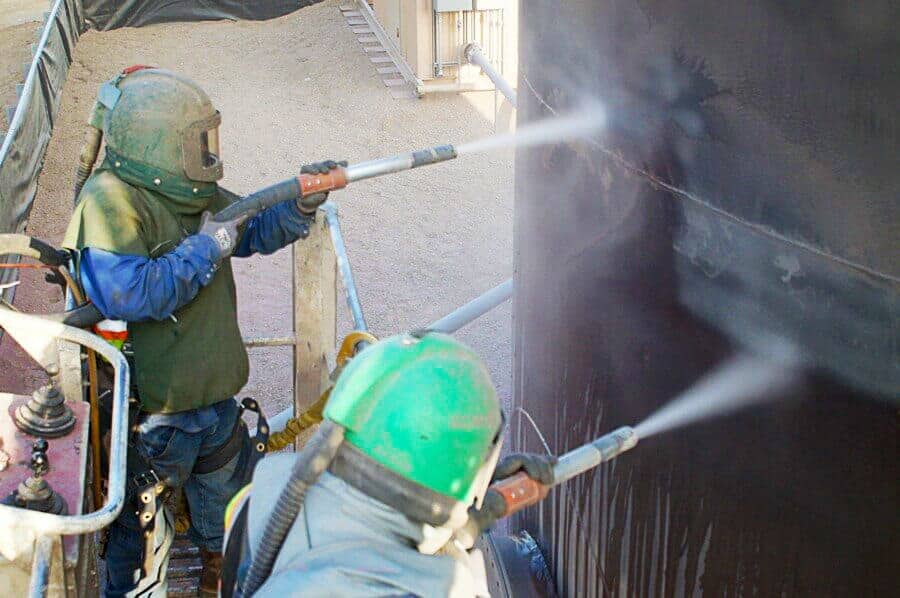
Surface profile also called anchor profile or blast profile is the microscopic topography created on a steel surface after abrasive blast cleaning. When abrasive particles impact the steel at high velocity, they create a random pattern of peaks and valleys across the surface. This creates the anchor profile coating adhesion depends on: the paint flows into the valleys, cures around the peaks, and is mechanically locked to the substrate.
Blast profile industrial coating specifications typically express surface profile in microns of Rz (mean peak-to-valley height), measured using testex replica tape and a spring micrometer, or using an electronic surface profilometer. Standard specifications call for profiles in the range of 40 to 75 microns Rz for most industrial epoxy and zinc-rich primer systems.

How Profile Affects Adhesion
Too little surface profile below the minimum specified for a given paint system means insufficient mechanical interlocking. The coating has a small contact area with the substrate, low effective adhesion, and is prone to disbonding under thermal cycling, impact, or chemical attack. Surface preparation for industrial paint that delivers inadequate profile is the second most common root cause of coating adhesion failure, after surface contamination.
Too much surface profile creates a different problem. If the steel peaks are too high relative to the applied wet film thickness, they can protrude through the cured coating creating a rash of pinpoint corrosion sites called soluble salt spots or paint holidays at the peaks. This is why anchor profile coating adhesion specifications have both a minimum and a maximum: typically 25 to 75 microns for most industrial primer systems.
Abrasive Selection and Sandblasting Surface Profile India
Sandblasting surface profile India operations must select the right abrasive to achieve the target profile. Common abrasives and their typical Rz outcomes include:
- Steel grit G25: medium profile, 40–60 microns Rz suitable for most epoxy primer systems
- Steel shot S230: low profile, 25–40 microns Rz used for shop primers and thin-film systems
- Garnet G30/G40: medium-high profile, 50–75 microns Rz preferred for immersion service epoxy systems
- Copper slag: aggressive profile, 60–90 microns Rz used for heavy industrial systems but can overshoot specification if not controlled
Surface Roughness Paint Application: Practical Considerations
Surface roughness paint application success also depends on ensuring the applied wet film thickness is sufficient to wet out the entire surface profile. A general rule is that the applied DFT should be at least 1.5 times the Rz peak height. For a surface with a 60 micron Rz profile, the minimum primer DFT should be 90 microns. Coating to below this threshold creates a pinhole-prone film that fails early in aggressive environments.
Paint Adhesion Surface Preparation Tips for Field Teams
These paint adhesion surface preparation tips apply to all industrial blast cleaning and coating operations:
- Always verify profile measurement with testex tape or a calibrated electronic gauge do not estimate from visual inspection
- Check abrasive contamination levels: used abrasive accumulates fine particles and contamination that reduce blasting efficiency and surface cleanliness
- Apply the first coat as soon as possible after blasting rust bloom on a freshly blasted steel surface can begin within two to four hours in humid conditions
- Repeat profile measurement if significant rust bloom is allowed to develop, as re-blasting to remove rust may alter the profile
Get the Foundation Right
Ashok Paint Agencies provides technical guidance on surface preparation for industrial paint to all customers, including surface profile specifications for each coating system we supply. Contact our team for product-specific application guidance and paint adhesion surface preparation tips tailored to your project environment.